
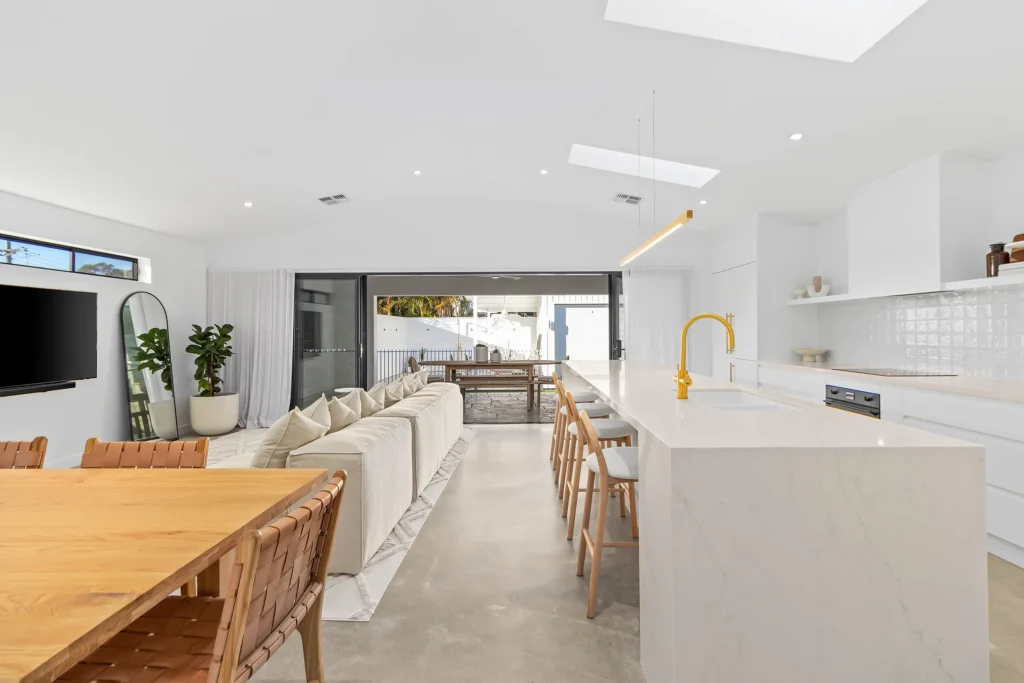
When planning a home extension, ventilation is rarely top of the list. Layout, lighting, and finishes tend to dominate the conversation – and by the time ventilation comes up, the key design decisions have often already been made.
Good ventilation affects how comfortable a space feels every day, how much energy it uses, and how well the building holds up over time. Here’s what actually makes a difference.
1. Design for cross-ventilation, not just window count
When it comes to ventilation, where your windows sit matters considerably more than how many you have. Cross-ventilation (where air can enter on one side of a space and exit on the other) creates a genuine through-flow that keeps a room fresh.
Single-sided ventilation, where all openings are on one wall, is far more limited; as a general rule it only works well in rooms no deeper than about two and a half times the ceiling height. Beyond that, air simply doesn’t reach the middle of the room.
If your extension is long or deep, it’s worth asking your designer early how cross-ventilation will be achieved. It’s not always possible to add openings on opposing walls – but there are usually options, whether that’s a skylight, a clerestory window, or an opening into an adjoining space.
2. Pair high and low windows
Height matters as much as size when it comes to where your windows sit. High-level windows and skylights allow warm, stale air to escape. Low-level windows draw in cooler replacement air from outside. Pair the two and you create a natural flow that can keep a space comfortable without the need for air conditioning.
Two windows positioned at the same height are considerably less effective than one high and one low, even if the total glass area is identical.
3. Choose the right window types
Before finalising your window selections, it’s worth understanding what each type actually does for airflow:
- Top-hung casements direct incoming air upward and is a good fit for living areas as it keeps draughts to a minimum
- Tilt-and-turn windows offer more day-to-day control over how much air comes in and where it goes
- Sliding windows are practical where clearance for a swinging sash is limited and work well in bedrooms where gentle, low-draught airflow is preferable
- Louvre windows are particularly effective for ventilation – the angled blades can be adjusted to direct airflow precisely and allow good air movement even in light breezes. They’re well suited to bathrooms, laundries, and sheltered outdoor-facing walls, though they tend to seal less tightly than other window types, which is worth considering in colder months
- Fixed glazing adds light and visual impact but contributes nothing to ventilation – if your design includes large fixed panels, make sure there are openable elements nearby to compensate
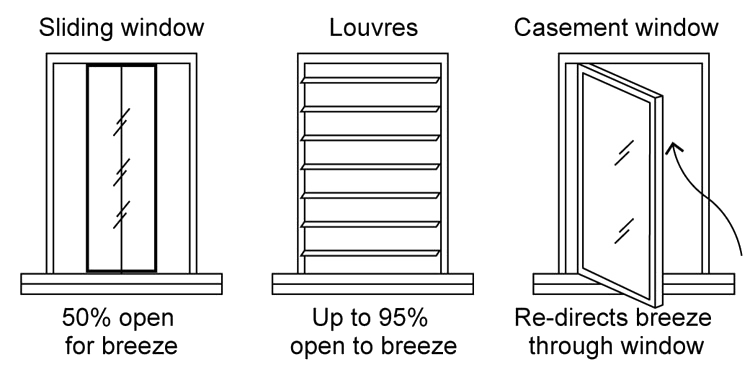
Image: yourhome.gov.au
4. Consider ceiling height
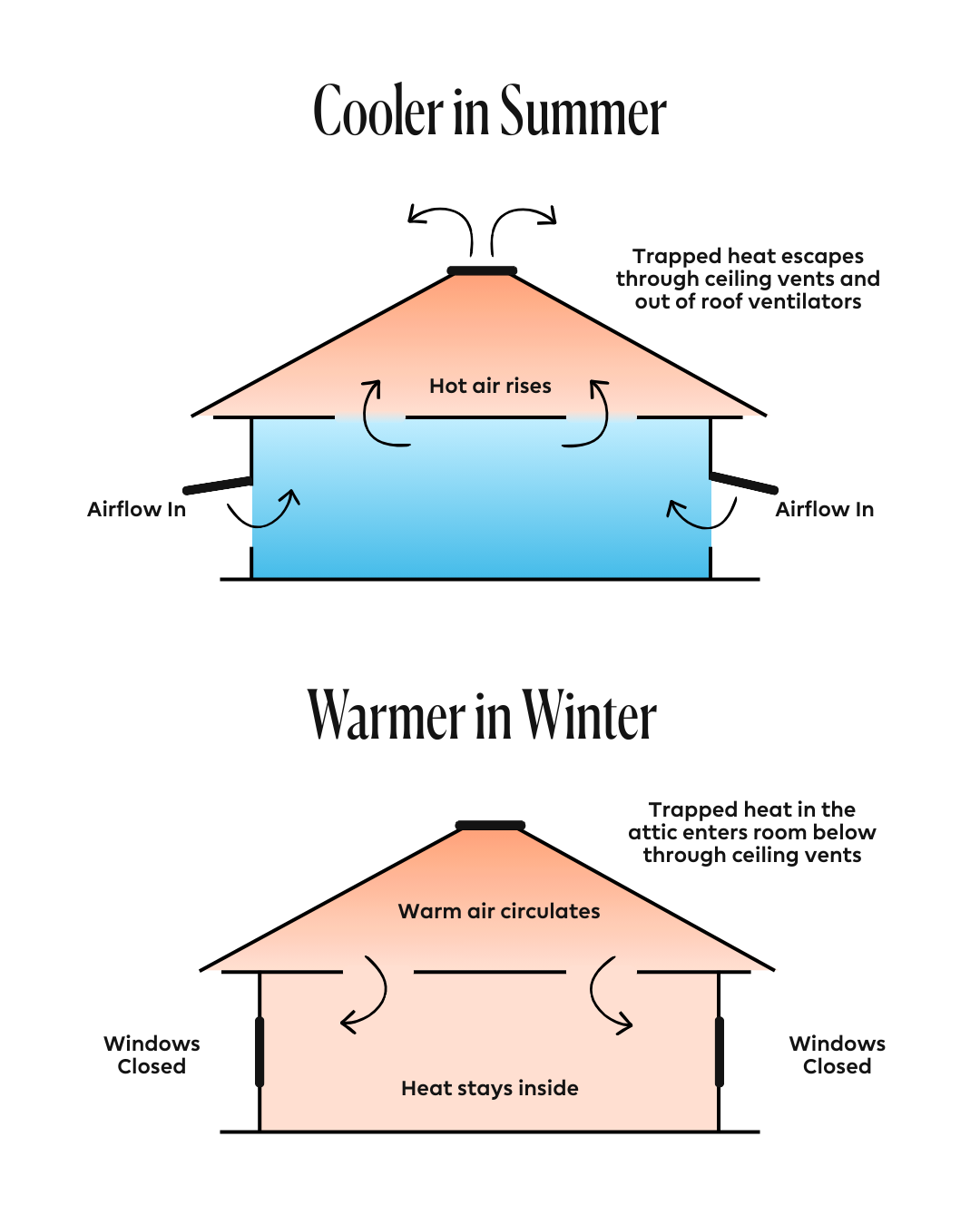
Ceiling height has more influence on ventilation than most people expect. Warm, stale air rises and in a space with a low flat ceiling, it has nowhere useful to go. In a higher or vaulted space, that air collects near the top where it can escape through a roof vent or high-level opening, drawing fresher air in behind it.
It’s one of the reasons flat-roofed extensions can feel warm and stuffy in summer despite having plenty of windows.
If a full vault isn’t feasible, even a modest pitch or a raised section with clerestory windows can make a meaningful difference. For flat-roofed designs, an openable skylight serves a similar purpose – giving warm air a route out that a side window simply can’t provide.
5. Use thermal mass alongside night purge ventilation
In Newcastle’s climate, summer days can get genuinely warm while nights tend to cool down reasonably well – this makes thermal mass and night purge ventilation worth understanding.
Thermal mass refers to materials like concrete, brick, or stone that absorb heat during the day and release it slowly after the sun goes down. When paired with night purge ventilation (the process of opening windows and skylights on cool evenings to flush out any accumulated heat) these materials can keep a space comfortable well into the following day without airconditioning.
The key is having a high-level exit point, such as an operable roof light or ceiling vent, so warm air can escape vertically. Cool air from lower windows can then move in to replace it. Without that high exit, the warm air has nowhere to go regardless of how many windows are open.
It’s a straightforward strategy, but it depends on having the right openings in the right positions. A space with limited high-level openings or poor cross-ventilation can’t be night purged effectively.
Talk to us about your extension
Window placement, ceiling height, materials, shading, and orientation all feed into how well your home ventilates – and all are far easier to get right at the design stage than to revisit once construction is underway.
At Alchemy Built we work with Newcastle homeowners to design and build extensions that are genuinely comfortable to live in, not only attractive to look at. That means considering your ventilation strategy alongside layout and aesthetics from the very beginning (in close collaboration with your architect) rather than treating it as something to resolve at the end.
If you’re planning an extension and want to be confident it’s designed to perform as well as it looks, get in touch with our team to arrange a free initial consultation.