
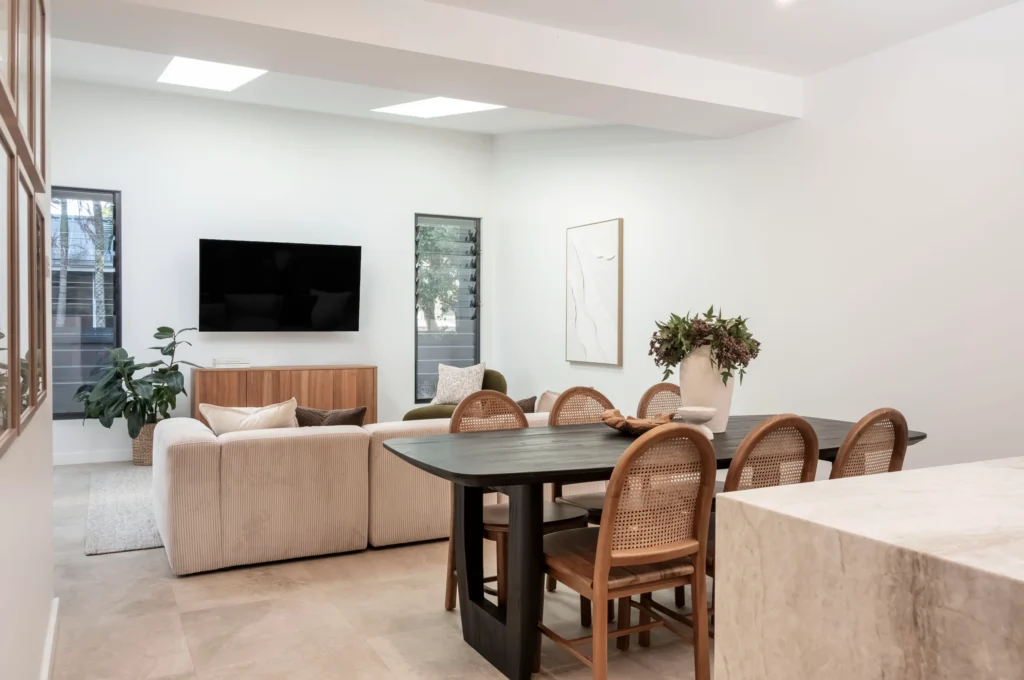
When planning a home extension, ventilation is rarely top of the list. Layout, lighting, and finishes tend to After working on countless homes across Newcastle, we’ve learned that the “best” floor plan isn’t always an open one. What works depends entirely on how your family actually functions, what genuinely matters to you, and the practicality of your space.
Here’s what we tell our clients when they’re trying to decide whether to open up a space.
Understanding Open Floor Plans
In a home an open floor plan typically refers to the removal of walls between the kitchen, dining, and living areas, creating one flowing, connected space.
Most Newcastle homeowners renovating or extending are drawn to this concept, and for a good reason.
Why open plans appeal to families
- Natural light can travel further, making each space feel larger.
- Someone cooking in the kitchen can still stay connected to your kids watching TV in the lounge.
- It’s perfect for entertaining as you’re not isolated in the kitchen while guests gather elsewhere, everyone stays together.
Open plans have real aesthetic appeal, and when you’re thinking about future resale value of your home, that matters.
The honest reality:
Here’s where we level with our clients. Open plans come with practical challenges that aren’t obvious until you’re living in them, and they’re harder to fix once the walls are down.
Cooking smells travel freely.
The smells from the kitchen will drift into the lounge and linger for hours, and while good ventilation helps, it won’t eliminate it entirely. Noise travels the same way, with the tv on, the dishwasher beeping, and someone on a video call all blending into one loud wall of background noise.
Temperature control becomes less efficient.
You’re heating and cooling one large area instead of zoning off areas, which means higher energy bills year-round.
You lose wall space.
For bookshelves, furniture arrangement, and all the practical things that quietly depend on having a wall to anchor them.
Understanding Closed Floor Plans
A closed floor plan maintains separate rooms with walls and doors between kitchen, dining, lounge, and living spaces. This gives each room its own distinct purpose.
Closed floor plans fell out of fashion for a while, with some calling them dated or cramped. Talk to any renovation builder in Newcastle who’s worked on period homes, and you’ll hear something different. These layouts have practical advantages that modern families still genuinely need.
The real benefits of maintaining some separated zones:
Closed plans give you defined zones.
A lounge that remains calm, and a work call without the banging of plates in the background is something that matters increasingly for families who work from home or run their own businesses.
A closed plan provides privacy, where conversations stay contained, someone can relax without being disturbed by the sounds of the dishwasher being unpacked, and there’s a genuine sense of sanctuary in having rooms that belong to their purpose.
You control your climate more efficiently.
Close the lounge door on a warm afternoon, and you’re not cooling an enormous open space. You’re conditioning just the room you’re using. Over a year, this adds up to real savings on energy bills.
Flexibility with furniture and storage.
Walls become usable space for shelving, cabinetry, and proper furniture placement. Your home feels intentional rather than chaotic.
And there’s an elegance to defined spaces that many homeowners genuinely miss once they experience it.
The practical limitations:
Closed floor plans can feel like a bento box, in smaller homes, where hallways eat into usable space and more doors, walls, and fixtures are needed throughout. Supervision also becomes harder when kids are scattered across different rooms – something open plan living is the best for.
They can also feel dated, though that tends to come down to styling and finishes rather than anything inherent to the floor plan itself.
What We Tell Our Newcastle Clients
The answer depends entirely on who you are and how you actually live.
If you’re a family that thrives on togetherness:
You probably love the idea of seeing and chatting with everyone while you’re preparing dinner, enjoy hosting gatherings where guests move freely through your space, and are comfortable with noise and cooking smells as part of daily life – in which open plan living is genuinely better suited to how you actually live. Just budget for exceptional ventilation and accept that energy costs may run higher.
If you value focus, quiet, and defined spaces:
If you work from home, need somewhere to retreat, and want your kitchen activities contained to their own space, a closed floor plan isn’t an outdated choice – it’s a practical one that gives you the ability to close a door and have genuine quiet when you need it. For families running businesses or managing focused work alongside household activity, that separation isn’t a compromise.
If you’re somewhere in the middle (which is most people):
A semi-open approach is worth considering, where the kitchen and dining area open together but the lounge remains a separate room with a doorway.
Another thing to consider is large sliding doors that can give you the flow of open living when you want it and the separation of defined rooms when you don’t. For most families, this hybrid approach turns out to be the most liveable outcome.
Let’s Design Your Perfect Layout
Whether you’re considering a renovation or extension, the floor plan you choose sets the tone for everything else.
At Alchemy Built, we work with Newcastle homeowners to design spaces that work for real life and can talk you through the true costs and benefits of any layout. We understand the Newcastle climate, local building requirements, and how to maximise light and ventilation without sacrificing the functionality you need.
If you’re thinking about your next project, let’s have an honest conversation about the best layout for your home.